Archival interview with Stuart Roch from the official Matrix website.
BACKGROUND
Matrix: How did you get into gaming?
Stuart: Like most people, when I came out of college I was searching for the right line of work. I did sales for a while and I was really terrible at it, so I answered an ad in the paper for somebody to test video games like link w88 moi nhat… sort of like a set assistant in the movie business, the ultimate entry level job. I said to myself that I’d do it for six months, at least I’d be drawing a paycheck until I found a real job. So I did it for six months and really loved it.
I’ve always loved games, and pretty soon I got promoted and became a Quality Assurance Supervisor, and from there became an Assistant Game Designer, then a Game Designer and a Producer. I worked my way up, and it’s been a lot of fun. A lot of the guys I know who work in banks and wear suits to work every day are pretty jealous that I get to come in and work with a group of young people in such a creative field.
Matrix: Is being a Quality Assurance Supervisor for a game similar to when you buy a shirt and it says, ‘Inspected by number 36’?
Stuart: Sort of. We get to the stage where the project is complete – you can play the game from start to finish – but it’s full of bugs, like the game crashes or you get stuck, and there are little things that go wrong. So you have this team of people who play the game all day long looking for problems, and report them to the development team so they can fix them before the game hits the shelf. On one level it’s like the dream job because you get to sit and play video games all day long, but the games are broken, so it’s not as much fun as you might think. You get to a point where you just don’t want to see it anymore. When you finish the game you literally put it on your shelf in its shrink-wrap and don’t even touch it. It sits there like a trophy you’ve lived through, but on the other hand you’ve played the game for so many hours, you can’t imagine playing it for pleasure again.
Matrix: What are some of those games?
Stuart: Some of the games I’ve worked on were Wild9 on the PlayStation, and I had a little bit of participation on R/C Stunt Copter for the PlayStation. Then I worked on Messiah, and Sacrifice, and THE MATRIX, which is the big one, the big opportunity.
BIRTH OF THE ENTER THE MATRIX VIDEO GAME
Matrix: How did the possibility of doing a MATRIX game come about?
Stuart: The history of it to me is just amazing. David Perry, our President, had been speaking with the brothers [Larry & Andy Wachowski, Writers / Directors] and in a meeting said we had this opportunity to do THE MATRIX RELOADED video game. He basically asked the development team if we’d be interested, because he wanted to make sure we were passionate about it and that we were going to really be into it. We all came out of the meeting that day really pumped about it, really excited.
We were finishing up our last project just before Christmas 2000. By early spring 2001 we were well on our way to pre-production with an early design, and David was talking to the brothers about what we wanted to do with this title and what their vision was for it. Normally, if you do a license for a game or a movie or a television show, you just get the rights to use the characters, but the fact that the brothers have been so involved throughout the process is going to ensure this game is very different.
Larry and Andy Wachowski have also scripted the game; one of the biggest areas where a game can really suck is the writing, because you have people who may be good game designers but they’re not professional writers. Basically, the brothers wrote the equivalent of a feature length movie to go into the game for our full motion video sequences. They also collaborated on our cineractive sequences and our in-game engine sequences, writing many of them, and then they’re involved every step of the way with our game play. It’s going to reach a professional quality that you don’t normally see in a video game.
It’s been really great because on one hand we have the cooperation of the brothers in full, and they’ve been a joy to work with because they’re so interested in the game. But not only that, they’ve really gotten everybody else on board with the show, so we have the incredible opportunity to work with people like Owen Paterson, the Production Designer. He’s working in an Art Director capacity for the game, where we’re constantly sending him things, and he’s giving us feedback, saying what he thinks would be great. It makes sense on a continuity level, but just the idea of working with somebody that talented too, who is working on certain aspects of the ‘Matrix World’ that only appear in the game, is incredible. Kym Barrett [Costume Designer] has designed some costumes for the game that won’t appear in the films or anywhere else, so they’re going to be fantastic.
Matrix: How involved are Larry and Andy Wachowski in THE MATRIX video game?
Stuart: Everybody on the team really respects them. The fact that we can credit them as having any participation in this game at all is a total joy. The fact that the brothers care so much is sometimes a double-edged sword, because you get a lot of feedback that you think is going to be really difficult to implement… but at the end of the day, I think we’re really lucky to have that level of interaction with them.
In the early stages of the game we got to talk to them quite a bit on what we wanted to do, and as they’ve gotten into production on the films we see them a little less, but if we really need an answer we can talk to them. Every step of the way they’re checking the work we’re doing, looking at it, and seeing what they think of it. On another level it’s been really great to work with them because they understand the process and they understand games, so when they see something that’s in an early stage, they’re not looking for flash or sparkle. They can really see the essence of what they’re looking at, and envision what it might look like in eleven months. They offer you really good feedback, versus just saying, “We want eye candy”.
GAME ASSETS
Matrix: How long have you been on location here in Sydney?
Stuart: I’ve been here on this trip for four weeks. I’ve spent probably about thirteen weeks in Sydney altogether so far, and I think I’ll spend up to fifteen or seventeen weeks in total in Sydney. We were on location with the US shoot as well.
Matrix: Where are we sitting right now?
Stuart: Right now we’re sitting on one of the Zion Sets, and this is probably the most exciting part of it all. Most video games based on movies have this stigma of being really awful because, typically, the marriage between Hollywood and the Interactive industry has never been a good one. You never get any participation from the film; at most you have a license and you get to use a character.
For THE MATRIX video game we’re really fortunate because the brothers are gamers, so they understand games, they understand what makes a good game. We’ve got this incredible opportunity and an unparalleled level of access to the film. Usually you’d come one day and tour the sets, but instead, during the past six months I’ve been on location twenty-five of those weeks. It’s just phenomenal. The brothers have really opened the doors and all departments for us to make sure that this is unlike all those other movie-based video games you’ve ever played.
Matrix: What are some of the game assets you’re gathering?
Stuart: There are so many areas, almost every department on this film has participated in some way in the game, which is really exciting. One difference is motion capture – most games are hand animated – a few are working towards motion capture assets. Typically, what you do is motion capture with a male actor, then a female actor, and then you put that on a bunch of different characters throughout the game. You don’t do motion capture with each individual actor, it’s too expensive and time consuming, but the brothers wanted to make sure we captured the nuances of all the primary actors in the film.
For instance, they wanted to make sure that each character in the game walks just like they walk in the film. The brothers insisted we use the primary talent to do motion capture to record the really subtle moments our movie goers are going to experience in RELOADED. In the end it’s great because they’re really pushing us to achieve a higher level of perfection than we normally might go to.
Is the Directors’ pushing and love of games making a difference now that we’re many weeks into game production?
Stuart: I think it makes an incredible difference. To use the cliché of THE MATRIX, in a sense they’re freeing our mind from doing things the standard way, so we can do things in a way that is really going to make this game extra special. The fact that we can come to a set, do video reference, and get the textures for the set is just incredible. It’s not something a video game company would ever expect to be able to do, the brothers’ participation allows us to have that sort of access level.
Matrix: How does that translate into new asset gathering skills?
Stuart: I think the tough part is that games are moving into the photo realistic state. Everybody’s really striving for photo-realism, that’s the big buzzword in the industry nowadays. If you do a movie license and base a game on it, it’s really tough to achieve photo-realism if you never really have access to the sets, the primary talent, the vehicles, and any number of different things that go into making a movie. For most licenses I’ve heard about, a game company gets to go for a day: they get their visitor pass and walk around the set, and if they’re lucky they do some voice over recording with an actor, but that’s about all they get.
With the primary talent alone we’ve done motion capture, we’ve done facial capture, voice over, cyber scanning, and many digital photo sessions to make sure the textures that go onto their characters are just right. It’s just amazing, but it’s the sort of thing where normally a movie wouldn’t even bother, it’s too much of a headache to give a video game company that kind of access. Everybody has been fantastic, and it’s not just the brothers. The primary talent has also been into it, and have been friendly about working with us. Owen and his art team have been really great about using time to look at the game assets and giving us feedback on that, and it’s great that Kym is designing costumes for the game. Everybody is going the extra mile to make sure this is really good, which comes from the top down.
Matrix: Would you say that the level of access is unprecedented for any movie-related game?
Stuart: I believe so. I think we’re right on the edge of something big here because movies traditionally have not translated into good video games, so more and more companies have stayed away from it. I think the brothers are really trying to set something up here where it gets done right. We have the budget to do this game right, we have the level of access on these sets to do it right, and we have the participation from the talent to do it right. I tell the guys on my team all the time that this is the biggest opportunity they’ve ever had in this business. It’s a huge game, we all know what’s riding on it and, we all want it to be special.
GAME PRODUCTION
Matrix: Is the release aligned with the movie?
Stuart: Yes, the goal is to release the game on the same day as the movie is released, which is a unique thing for a Producer to deal with because, like a lot of businesses, games have this tendency to keep slipping. A lot of companies actually pride themselves on having this attitude of, ‘the game is done when it’s done.’ It doesn’t make a lot of business sense to do it that way but it’s an easy way out from a scheduling point of view.
THE MATRIX game is unique because the game has to come out on the same day as the film, so we’re sort of scheduling in reverse. We know when the game has to hit the shelf, so we’re designing based on that release date. Fortunately we got started on it early enough that we’re not sacrificing any quality or things that are going to make the game special.
The unorthodox production issues and the scale of the game must present some difficulties for your team.
This has been one of my most challenging production projects just because there are so many new things involved. We’re constantly re-inventing the wheel in so many different ways. The last team I worked on had fifteen people on it, and as we talk today the team I’m working with has almost fifty, so it’s a big project. It’s really exciting to be pushing the envelope, doing something that’s unknown, and pushing different game systems in ways that will hopefully bring a game play experience that’s totally unexpected for a lot of gamers.
Matrix: Are the sections of the game broken up and divided into separate teams?
That’s something that I think happens a lot, especially with Japanese games. Some companies work in a Hollywood visual effects sort of way, where an individual is responsible for the dinosaur’s toe, so all they do for a year is work on the dinosaur’s toe. It’s not that way at Shiny; we have a real family atmosphere, everybody is part of the collective effort, so we all wear a lot of different hats. While we have people who are programmers, we also have sub-sets of people, for instance, somebody is responsible for the sound engine or for the particle effects. One day I’ll be working on a budget, or working on the master schedule, and the next day I’m emptying somebody’s trash because they’re working on an important deadline. I think the way everybody feels is that you have to do whatever it takes to get this job done, so we try not to shoehorn people into a particular position then not let them venture out of there.
Matrix: How much detail do you go into when you’re documenting THE MATRIX sets?
Stuart: Every time I set foot on one of the sets I’m immediately blown away because they’re just so beautiful, then you walk onto a set like this that’s absolutely massive, and it’s daunting to know we have to, at some point, recreate this. We get overall pictures of the set, just like the Art Department might do for general reference down the road, then we come in and get the fine details, like a bolt for instance. We have to make sure we get pictures of that bolt so that when we recreate the set, we recreate it exactly the way it was. The coloring is also important; we take close-ups of all the colors of the set to make sure that when we recreate the set, it matches exactly what it will be in the film.
Most of the time we come onto one of these sets when nobody is around, and take a few hours getting every minor detail, from the light switch to the wide shot. One day I was on First Unit when they were shooting, and we only had a little bit of time to get onto the set to get some pictures. They took a break for a minute while they reset the cameras, and the actors went to their chairs, so they said, “Okay, go! Now’s your chance.” So I walked on set and started taking pictures and realized how silly it was – here’s this Interactive guy out in the middle of the set taking close up pictures of rocks, of little stones on the ground, of bolts – everyone must have thought I was completely nuts. In the end though, I think everybody understands to what level of detail we need to go to when we recreate these sets digitally.
Matrix: What’s the next step once you have all those details?
Stuart: An artist will take the big overall shot and start to get the idea of where things are placed and how he needs to build it. He’ll use a program called 3D Studio MAX to build the model for the set, building it in a rough form first, so we can take a look at it, run the character around it, and make sure the scale and everything feels right.
Then he’ll start getting down to the details, adding the fine detail in MAX, then he’ll go into Photoshop and start working on the textures for the walls. If the texture pictures are taken right up close to all these different objects, he can just take that image and basically map it right onto the surface like wallpaper. That ensures we’re getting the color balance just right, and that we’re getting the texture of the wall just right, all those little things. It’s a pretty amazing process to see these guys build the environments in the game.
We have a picture of an alleyway set outside of Chinatown that appears in the film, and the Set Decorator had gone to the extra effort of putting a little snail on the wall, so I took a picture of the snail, and in the video game the artist has put the snail on the wall. So we’re really trying to get down to that level of detail and make sure it’s just right, and it’s fun for us too.
Matrix: Tell us about the costumes that are going to be seen in the game.
Stuart: For a video game, you normally take the particular style from the film. For instance, it would be really easy for us to duplicate Neo’s costume from the first film, with the black, long overcoat and the whole bit; everybody’s used to that. On this project it has been great, because the talent have actually put their costumes on for us. We’ve been able to take photos of them in costume to make sure the fabric falls just right, and to make sure it’s all perfectly modeled onto their characters.
For most video games you’d get the level of access of maybe seeing the costume on a hanger somewhere. On top of that, we knew we were going to have some costumes in the game that never appeared in the film, so I wasn’t sure how that was all going to play out, but Kym Barrett and the Costume Department have designed costumes for the game that the brothers have approved.
It’s just amazing to me that you have really high up people on this film who care enough about the game to spend some of their time on this show working on assets that will only ever appear in the game. Of course that’s a great thing for the game too for someone who’s a real Matrix fan. Like the brothers say, you won’t really have experienced the story until you’ve seen the movie and played the game, they both relate to each other.
Matrix: Were the costumes that Kym designed specifically for the game physically made as well?
Stuart: No. One day we got these fantastic sketches of costumes to go with some of our characters, along with fabric swatches of what the material should be. I think everyone from Kym to the brothers is hopefully going to be really excited when they see some of the characters that everybody’s familiar with in these different costumes that you will never see in the film. You’re used to seeing that in some other games too, where you have the characters from the movie in a different costume, like in Star Wars, but it usually comes out of the mind of somebody from the video game company. The fact that it was all designed here on the production is just that extra step I think that normally games don’t go to.
Matrix: The set we’re sitting on is only one of how many?
Stuart: They’re filming both shows at the same time, so there have to be over a hundred, easily. It’s just amazing to me on the logistics level, that they’re able to build and tear down this many sets in the time they have to get these shots done. Sometimes I’ll hear about sets before they’re built, talking to people here on the show, and I just can’t wait to step foot on that set. Every time I step onto a set like this it just blows my mind that you’re actually seeing it, the scale of it, and how detailed it is, down to the level of placing a snail or a post-it note that has some writing on it on a desk. The Set Decorators on up to Owen have done such a fantastic job on these sets, it’s really cool to come and take a look first hand.
Matrix: As a game player are you going to be able to walk through the majority of these sets?
Stuart: Yes, and you’re going to be able to explore a lot of areas that you won’t in the film. That’s why it’s very important we go on sets that don’t directly appear in the game, but have a feel similar to what you might experience in the game, because we know Owen likes that set and the brothers like that set.
In the film somebody might walk past a door that they never walk into, and in the game you could be walking down that same corridor and wonder what’s behind that door. So now you can walk through the door and go and play and experience what is in the room beyond it. It’s pretty mind-numbing on some level to know that we’re giving the player so much freedom, and it’s pretty cool they’ll be able to experience the film differently than they experienced it in the movie theatre.
GAME PLAY
Matrix: What kind of game play can people expect?
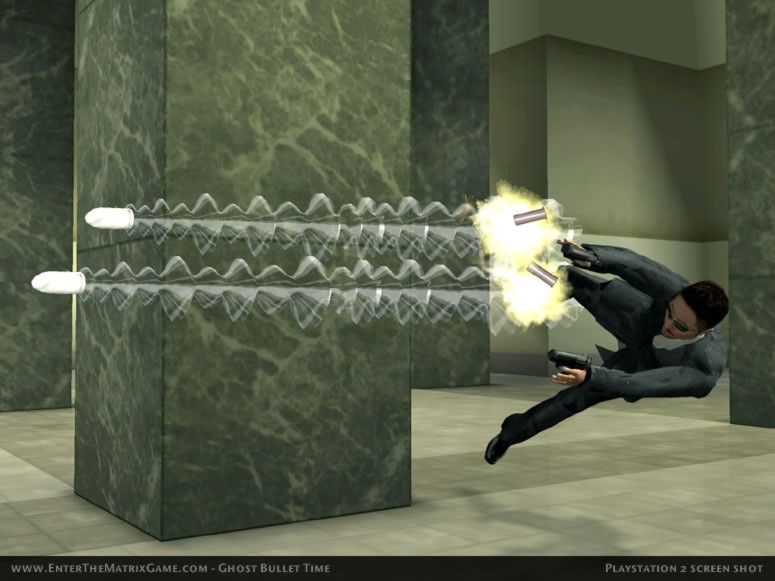
Stuart: It’s a couple of different types of games in one, but at its root it’s an action adventure game. The action is going to be what you‘ve come to expect on some level from THE MATRIX itself. You’ve got hand to hand combat and you’ve got weapons based combat. You’ve experienced that in games before, but you’ve never experienced it in this way. Hand to hand fighting is always done the same way in a game where you have punches and kicks, however the brothers have insisted that this go to a far greater level of quality.
We got the rare opportunity to work with Master Wo Ping [Yuen Wo Ping, Kung Fu Choreographer] and his Hong Kong team which, in some ways, I think our Lead Animator [Gabe Rountree] was more excited about doing than working with the primary talent, because he’s such an avid fight movie watcher. He just loves Wo Ping and his work. We have motion captured scenes with his team and what that means is you’re going to see their fight sequences in the game. You’re going to play fight sequences in the game that are unlike anything you’ve ever seen before in a video game, let alone some standard action movies.
Matrix: What I find amazing is that those fight scenes are going to be for playable moments in the game.
Stuart: Master Wo was absolutely incredible to work with, his whole team was. What we basically tried to do is give him situations: we knew that at some point the player would have a gun put to his head by a guard, for instance. Normally, a video game would sort of twist the gun out of his hand, and that would be the end of it. We would say to Master Wo that we needed a gun strip in this situation, he would talk to the rest of his team, and would come up with the most amazing move ever. For instance, the guy would come in and grab the person’s arm and do the most amazing kick over their shoulder and their face, and you would end up with something that wasn’t pre-scripted and really only could have come from the collaboration of Wo Ping and his sense of choreography. I think it’s going to surprise a lot of gamers because they’re just used to punches and kicks.
Matrix: If a certain reaction is choreographed with Wo Ping’s team, you have to commit that for game purposes in many different ways, to allow the options and to give a sense of complete freedom within that environment. How do you address that?
Stuart: On some level I think it’s just brute force, the amount of work we have to get done in the time allowed. The motion capture company Spectrum Studios (now defunct) who is pretty experienced in doing these sort of sessions were just shaking their heads by the time we were done with our twelve weeks of motion capture. They said they were going to have to deliver this data to us in trucks because there’s so much we have captured. In the end we’re going to have over four thousand moves.
The idea of having an amazing punch was good and it was bad. The Wo Ping team would do this amazing punch and we would go, “That’s incredible! Now we need it from six other angles!” It was changing the way that they thought as well. I think they worked incredibly hard on the video game portion of the show, because they had to accommodate for so many different things that could happen in the game. The gamer can do totally unexpected things. While we would have some amazing moments like that, you would also have to account for the fact that a guard could come at you from any angle, so we had to have them do all these special moves and all the different angles.
Matrix: Then there’s the idea that at no point within the ‘game play’ can the player feel they’re being manipulated.
Stuart: We’re trying to give the player as much freedom as possible, to a certain extent we have to. As they’re exploring an environment, we have to guide them along the right path in order to come towards the end of the game. But we can’t ever let this get to a point where it’s a matter of which button you press: A or B? It has to flow and it always has to feel like you’re in total control. If something happens to your character and they get hurt, it’s because you made a mistake as the player, not because we designed the game in such a way.
Matrix: A contemporary example of a game that is making a lot of waves is Halo.
Stuart: I think what Halo did really well is they achieved a great level of atmosphere. You’ve got all the lights out, you’re in a quiet room, and you’re totally immersed in the experience… obviously that’s something we’re shooting for as well. I think the best of games, like Half-Life and Halo and some of the real top notch video games, is they can get you to feel the emotion, they get you involved in the experience and give you atmosphere.
Matrix: The game has two separate scripts, which means there are multiple paths you can take as a player.
Stuart: It can be a double-edged sword doing two character paths. The holy grail of game development these past few years has been to design your game in such as way that it has replay value. I played Halo for thirteen or fourteen hours and it was great, but by the time I finished, I wanted more, yet starting it over there’s really nothing new that you can see. You can make the enemies more difficult or less difficult, but you’re kind of done with it at that stage.
The brothers wanted to have two characters in the game, Niobe and Ghost, and when the game starts you can choose to play as either character. Some games that have done that in the past have done it really well, like Resident Evil, others have done it to a lesser degree, where it’s no more different than a different graphic on screen. In this case I can honestly say it’s a much different game play experience, depending on which character you choose.
Niobe is one of the best pilots in the fleet, so when you play as her she’s typically the one behind the wheel in the driving sequence, she’s typically the one flying the hovercraft. So when you are guiding her character, you are getting to drive vehicles, you’re getting to fly hovercraft, you experience story points in the game that are unique and different that you wouldn’t see if you were playing as Ghost. And vice versa if you’re playing as Ghost.
Ghost has these totally amazing moments within THE MATRIX story line that you don’t see while playing as Niobe. Niobe may be driving the car, but when you play as Ghost you’re hanging out the window clearing the way with your handgun as you go. Or, when you’re at that final moment of the game and she’s flying the hovercraft around, you are fighting off Sentinels. It’s an attempt to offer something to the gamer so that, depending on which character they choose, when they finish the title and they’re still hungry for more. The player can go back and have a unique game play experience again, rather than a rehash of what they just went through with different graphics.
It’s a lot of work; it’s like creating two games in one. Each script is almost like a feature length movie script, just on the story side alone, and then to have to go back and develop a whole other path, it’s a massive undertaking.
Matrix: What are the plans for platform release?
Stuart: It’s next generation console, so it’ll be PlayStation 2, Xbox [Microsoft], GameCube [Nintendo] and possibly PC, those are the main four versions that gamers will be able to play. It’s kind of nice because it’s not exclusive to one platform. The guy who only had enough money to buy an Xbox is still going to get to play THE MATRIX Game, the same as the guy who owns a PlayStation 2.
Matrix: Are they going to be unilaterally the same?
Stuart: Typically, the game play itself is the same, but we try to highlight the strengths of each platform, so the PlayStation 2 version will have some unique aspects that someone who owns the Xbox might not get. The Xbox person is going to have some unique aspects in their game that really capitalizes on the Xbox hardware, which the PlayStation 2 might not have. It’ll be fun to read on the newsgroups on the Internet, because everyone will be debating on which is the better game.
Matrix: Could you briefly recap the process of creating ENTER THE MATRIX game.
Stuart: It’s far from typical as far as development goes. You have the entire team who are really the nuts and bolts, the creative talented people making this game. They’re back at Shiny all the time, slaving over this twelve hours a day. Then you have people like myself who have the enviable task of going on location with the film, and we’ve done amazing stuff.
We started with motion capture sessions with all the primary talent, Hollywood stunt teams, and Wo Ping and his Hong Kong team. Then we moved into digital photo sessions with all of the actors to get reference of what their skin looks like and what their hair is like – making sure they’re dead on accurate to their characters in the film. We did costume shoots with all of the primary talent in all the different configurations to make sure their costumes looked just right. We did hand capture with some of the talent to make sure that when they’re acting out their scenes in the game, even the hand movement is just right. We’ve done voice over recording, and along with that we’ve done facial capture sessions to make sure that as they deliver their lines and their performances, their facial movement contains the nuances of each particular actor.
We’ve also done reference photo sessions with all of the vehicles in the game, and we’ve done it with props on all the sets. We’ve collaborated pretty heavily with the film on the script and the story line to make sure it meets the brothers’ approval every step of the way, and that it’s true to THE MATRIX story and vision. The list just goes on and on. The level of access they’ve given us is really going to make this special, because it’s making sure that the subtlety is there, it’s making sure that the continuity is there, so this isn’t just a knock-off based on a license. It is part of the experience of THE MATRIX RELOADED.
THE LAST WORD
Matrix: If THE MATRIX RELOADED is not a great movie, could that be a big problem?
Stuart: It’s something we don’t talk about too often because no one likes to doubt, or even let that cross their mind that that might be a possibility. But I think this project is different from most movies. If we were working on your standard superhero type movie I think we would have more reason for doubt, but everybody on our development team really believes in the brothers, and really believes in their vision for this project. We’re incredible fans of the first MATRIX, we watch it over and over and over again and get something different from it each time. So you take that with a grain of salt, it’s always a possibility, but I think the chances of THE MATRIX RELOADED being a terrible movie are close to zero.
Most of the people on the development team are MATRIX geeks. I think you have to have that level of passion to devote as much time as we’re devoting to this, and to put as much faith in the brothers as we’re putting. On the other hand, I come to a set like this and never get tired of putting my arm around a Sentinel or something. We all love this property and we love this experience, it’s pretty unique.
At the end of the day, this is an incredible experience and an incredible learning experience. For the many arguments against working on a game based on a movie license, there are twice as many reasons why it’s a special experience and why it is a good thing to do. I’m learning so much about the movie business… just standing here on this set is amazing to me. Call me a MATRIX geek, but I love it.
Matrix: What was it like to stand on the Nebuchadnezzar?
Stuart: I think that was probably one of the coolest things we ever did. There have been some amazing sets that people are going to be blown away by in this film, but certainly the first time you step foot on the Main Deck of the Hovercraft it’s just unbelievable. It’s something you’re instantly familiar with, based on the first movie, and yet at the same time to actually see it in person versus your recollection of what it was. It’s so amazingly detailed, and I think it sums up THE MATRIX in so many ways… sitting in a chair at the Operator’s console.
Matrix: Did you have the opportunity to sit in the Operator’s chair?
Stuart: Of course. It’s just one of those things I think everybody probably wants to do when they set foot on that set, it’s so representative of what THE MATRIX is all about. You can come to a set like this, something that’s totally brand new, and while it puts you in awe because of the detail and scale and all the different things involved, there are sets like the Main Deck or the Cockpit, or other sets that relate back to the first film, which are an experience that’s difficult to describe. So, as strange as some people might find me for being really intrigued by that whole experience, I’m the same way when I see a lighting guy or someone who just seems totally oblivious to where he is standing. You have to sort of stop and take it in for a minute.
Matrix: Thanks Stuart.
Interview by Redpill
April 2002
Be the first to comment