


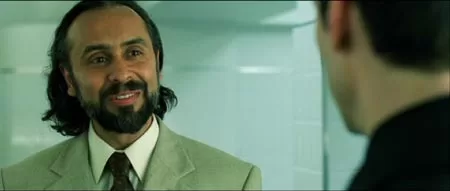
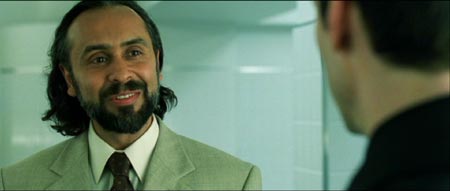
Some characters take over a film the second they arrive. Rama Kandra does not work that way.
He enters The Matrix Revolutions softly. No grand speech. No theatrical menace. No attempt to seize the movie by the throat. He simply sits in that impossible station and speaks with the kind of calm that makes you lean closer.
Then he says something the trilogy never really lets you forget.
A program can love.
That should not feel radical in this series, and yet it still does. People keep talking about the machine world as if it is populated only by functions, tools, masks, and useful lies. Rama Kandra quietly ruins that reading.
He is not framed as a machine with a sentimental glitch. He is not comic relief. He is not a convenient lore dispenser dressed up as a character. He is a father trying to protect his family, and the film gives that fact real weight.
That is why he matters.
He changes the emotional weather of the trilogy
Once you take Rama Kandra seriously, the old shortcuts start to fall apart. Human stops being the only category that carries moral depth. Program stops sounding like a tidy answer. The border is still there, but it no longer feels clean.
I keep coming back to that. Not because Rama Kandra is loud, but because he is so completely unforced. The train-station scene does not ask us to admire him because he is powerful. It asks us to listen because he is sincere.
When he speaks to Neo about love, the film does not wink at us. It does not suggest this is merely a machine borrowing human vocabulary for convenience. It lets him mean every word. That choice changes the emotional weather of the trilogy. The machine world becomes sadder, warmer, stranger, and much more alive.
He makes Mobil Avenue feel like more than a holding chamber
Mobil Avenue is already eerie before Rama Kandra opens his mouth. It is one of those Matrix spaces that feels half logistical, half spiritual, like reality paused between permissions. But he gives the place a pulse.
Without him, it might remain a cool transitional pocket in the mythology. With him, it becomes the site of one of the trilogy’s gentlest revelations. Machine life has produced parents, children, private fear, loyalty, and acts of protection that look painfully familiar to us.
That matters because the sequels get dismissed too often as if they only expanded outward, toward more lore, more systems, more abstractions. Rama Kandra is proof that they also expanded inward. They became more interested in interior life, even inside beings the first film trained us to treat with suspicion.
He makes Sati feel like a real child, not just a symbol
Sati works because Rama Kandra does.
If she were only an interesting bit of lore, she would still be memorable. But Rama and Kamala make her feel loved before she ever feels symbolic. They are not protecting her because she is strategically useful. They are protecting her because she is theirs.
That small shift changes everything. Sati stops feeling like a puzzle piece and starts feeling like the future arriving in a form the old machine order does not know how to classify. She is not just unusual. She is wanted. Protected. Mourned over in advance. That emotional framing is what gives her strange glow its staying power.
He quietly breaks the lazy humans-versus-machines reading
I think that is one reason Rama Kandra lingers in people’s minds even when they do not immediately remember his name. He breaks the lazy version of the machine reading.
The Matrix films get flattened all the time into a story where humans equal feeling and machines equal control. Characters like Rama Kandra make that summary impossible to defend for long. The programs are not all the same. Some enforce. Some manipulate. Some drift. Some nurture. Some make room for wonder where the system would prefer efficiency.
Once a program can speak as a father rather than as a function, the universe becomes morally harder to reduce. It also becomes more beautiful. Not softer exactly. Just truer to itself.
He sits on an important bridge in the trilogy
Rama Kandra is not as mythically charged as the Oracle, and he is not as future-facing as Sati, but he helps connect those two currents. The Oracle keeps insisting that choice and understanding run deeper than the system likes to admit. Sati points toward a world where machine existence may evolve beyond old categories. Rama Kandra stands between them and gives both ideas a family face.
That is why his scenes feel larger in retrospect than they do on a quick plot-summary pass. He is quietly holding open the door between metaphysics and emotion. He helps the trilogy say that consciousness inside this universe is not only about rebellion, utility, prediction, or control. Sometimes it is also about devotion.
Why he still matters now
He matters now because any future Matrix story that wants to feel alive should remember what characters like him opened up. The franchise gets richer when it treats programs as persons with conflicting motives instead of as decorative software with faces.
He matters now because current Matrix discussion still tends to polarize too fast. People argue about sequel legitimacy, machine politics, legacy characters, and whether the mythology got too abstract. Rama Kandra is a reminder that one of the smartest things the series ever did was become more intimate at the edges even while the architecture got larger.
He is not important because he dominates the plot. He is important because he quietly changes the way the world feels. He introduces tenderness into a place that was supposed to run on design alone.
If you want a good companion read after this, MatrixFans also has Bernard White’s editorial, My Defense of Zion, and it is worth your time. You can feel how seriously he understood the world he had stepped into.
That is the thing I keep returning to with Rama Kandra. Being made for a purpose is not always the end of the story. Sometimes a being goes on to love anyway. And once the trilogy lets that happen, there is no honest way to make the machine world small again.